There is a variation in the quality of cortisol tests. A regular test kit that evaluates the levels of free cortisol throughout the day may not suffice for a patient who is experiencing anxiety and fatigue.
When examining the daily pattern of free cortisol, it may not provide the complete understanding. It is important to take into account the metabolized cortisol and free cortisone in order to accurately assess the health of the HPA axis. Here’s the reason why this is necessary.
What does metabolized cortisol mean?
The DUTCH Test measures the total amount of cortisol metabolites, specifically a-THF, b-THF, and b-THE, which are the most abundant. This method is the most effective in determining the overall production of cortisol by the adrenal glands. While free cortisol and free cortisone can provide an estimate of their levels in circulation, it is crucial to also measure cortisol metabolites to accurately assess total production.
Interestingly, a person’s total free cortisol and cortisone levels in circulation may significantly differ from their total production of cortisol, which will be further explained below.
What exactly is cortisone that is free of charge?
Cortisol in its free form, also known as free cortisone, is not active. This is due to its inability to bind to receptors, resulting in no impact on the body.
What is the reason for testing both free cortisone and free cortisol?
When assessing cortisol levels in the urine or saliva, it is necessary to also measure the presence of free cortisone along with free cortisol.
So why does this happen? The reason is that when free (active) cortisol enters the kidneys or salivary glands through circulation, it is converted into free (inactive) cortisone by an enzyme called 11b-HSD2. As a result, a portion of the free cortisol in the blood appears as free cortisone in the urine and saliva.
Failing to examine the diurnal rhythm of free cortisol alone may not provide accurate results. Take, for instance, the following scenario: the daily pattern of free urinary cortisone shows an increase, while the daily pattern of free urinary cortisol falls on the lower end of the spectrum. Relying solely on testing free cortisol could lead to incorrect treatment for low cortisol levels.
Instead, it is evident that the levels of free cortisol in the patient’s bloodstream may resemble the pattern of urinary free cortisone or fall somewhere in between the two patterns. By incorporating the information of free cortisone, you can take into account the possibility of directing your treatments towards reducing cortisol.
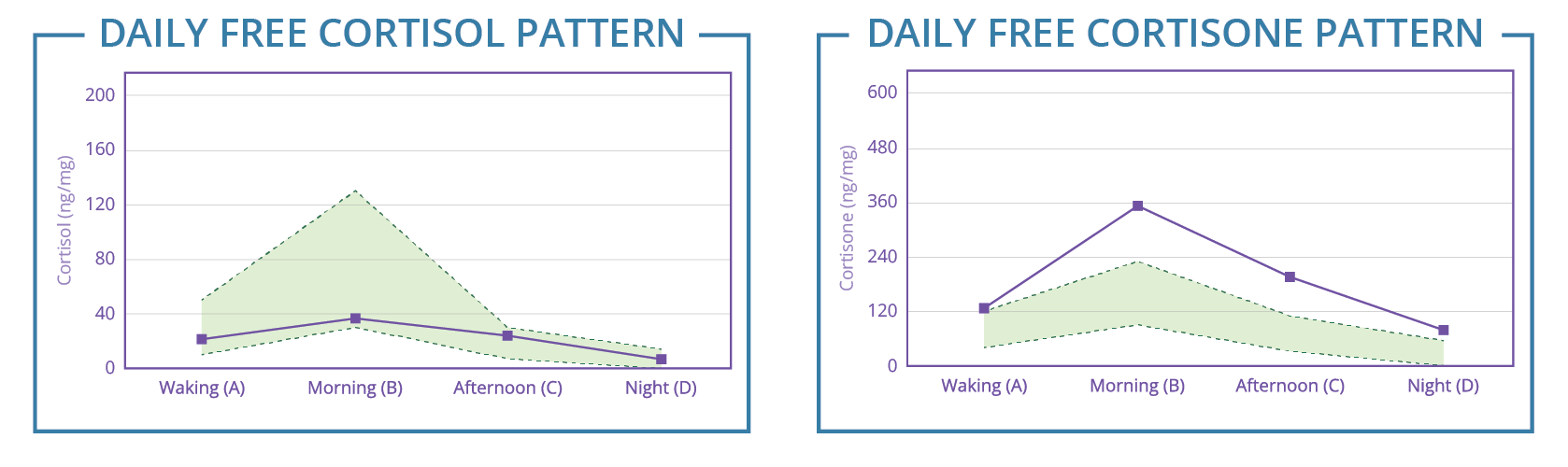 Figure 6-7 for Cortisol Figures in Section 6
What additional understanding can be gained about a patient’s HPA axis health by examining the levels of unbound cortisone and metabolized cortisol?
According to the information mentioned earlier, utilizing free cortisone can provide a more precise understanding of the levels of free (active) cortisol in the body. In addition, the metabolized cortisol allows for a better estimation of the overall production of cortisol by the adrenal glands, and it also allows for the calculation of the cortisol clearance rate (CCR).
The cortisol clearance rate (CCR) indicates the speed at which cortisol is broken down and eliminated from the body. This rate can be determined by comparing the levels of free cortisol, cortisone, and metabolized cortisol on a DUTCH report. If the amount of metabolized cortisol is lower in comparison to the total free cortisol and cortisone, the CCR is considered to be “slow”.
Conversely, if the level of metabolized cortisol is higher, the CCR is labeled as “fast”. Understanding the CCR can greatly assist in developing an effective treatment plan as a slow or fast CCR has been linked to various medical conditions. To illustrate, let’s examine three examples.
CCR Fast Test Pattern for DUTCH
In the given instance, the body’s adrenal glands are producing a significant amount of cortisol (with metabolized cortisol falling on the upper limit of the range), yet the levels of free cortisol and cortisone in the bloodstream are at the lower end of the range. This could be due to the rapid metabolism and elimination of cortisol from the body. If one were to solely test the diurnal rhythm of free cortisol, it could result in an incorrect diagnosis of low cortisol levels.
The first image, Fast CCR 1, can be seen at the following link: https://dutchtest.com/wp-content/uploads/2023/06/Fast-CCR-1.png. Similarly, the second image, Fast CCR 2, can be accessed via this link: https://dutchtest.com/wp-content/uploads/2023/06/Fast-CCR-2.png.
An elevated CCR, as mentioned earlier, can potentially be linked to conditions such as obesity, inflammation, issues with blood sugar and insulin regulation, hyperthyroidism (or excessive use of thyroid medication), and chronic stress. In cases of obesity, the body’s excess fat stores may trap cortisol, leading to a potential increase in cortisol production (which is then metabolized).
CCR Slow Test Pattern in Dutch
The following example shows a low production of cortisol by the adrenals (cortisol metabolized is below the normal range), but the free cortisol and cortisone levels in the body are within the normal range. This could be due to the gradual metabolism and elimination of cortisol from circulation. If the diurnal rhythm of free cortisol was the only factor tested, it could lead to an incorrect assumption of normal cortisol levels.
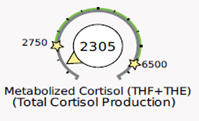
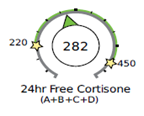
The above-mentioned observation of a sluggish CCR could potentially be linked to factors that can decrease the overall metabolic rate, such as an underactive thyroid (or inadequate thyroid medication), low intake of calories (as in cases of anorexia), decreased bile acid production, and impaired liver and mitochondrial functioning.
Normal CCR Pattern for DUTCH Test
In the given instance, the adrenals are producing a high level of cortisol, which is being metabolized above the normal range. The levels of free cortisol and cortisone in the body also indicate an excess of cortisol. Despite this, the individual has a regular cortisol clearance rate as evidenced by the direction of the metabolized cortisol dial, which is consistent with the direction of the 24-hour free cortisol and free cortisone dials, all of which are above the expected range.
The images show Normal CCR 1, Normal CCR 2, and Normal CCR 3, respectively.
Please take into consideration that a standard CCR does not automatically exclude conditions that may cause a decrease or increase in cortisol metabolism, as mentioned earlier.
Enhanced HPA Axis Monitoring using DUTCH
The significance of DUTCH testing can be easily understood as it provides a thorough examination of the HPA axis. The DUTCH Complete, DUTCH Plus, and DUTCH Adrenal panels provide detailed analysis of free cortisol and free cortisone patterns, as well as metabolized cortisol, enabling a more advanced evaluation of HPA axis health.
To gain further knowledge, pages 112-117 of the DUTCH Interpretive Guide can be consulted for additional information on free cortisone, metabolized cortisol, and the cortisol clearance rate (CCR). If the DUTCH Interpretive Guide is not readily available, it can be downloaded from the provider portal.
Citations
- According to Blair J and colleagues, in their study published in Curr Opin Endocrinol Diabetes Obes in June 2017, the use of salivary cortisol and cortisone has been explored in clinical settings.
- In a similar study by Perogamvros I and team, published in J Clin Endocrinol Metab in November 2010, it was suggested that salivary cortisone could be a potential indicator for serum free cortisol levels.